
The easy answer fits in one sentence: I was born into a Christian family. As a child, nobody asked for my opinion on Sunday mornings. Church was not a choice, it was a fact, like the language spoken at home or the dish served on special occasions. Christianity was my cultural inheritance before it was my conviction. And for a long time, I believed that this was what being a Christian meant: having faith, feeling the Lord in your heart, and not asking too many questions.
I have written elsewhere that domination is not racial but human, and that we must have the courage to turn the mirror back on ourselves. I have also written that a principle, if it is true, must apply universally, and not only where it is convenient. Today, I am going to apply my own rules to the most intimate subject there is: my faith. Because the sociologist Pierre Bourdieu is right about something that should trouble every believer: what we hold as obvious is largely manufactured by our environment. A young man born into a Christian family finds it obvious to believe, exactly as a young Parisian of 2026 finds it obvious to doubt. Neither of them has conducted an investigation. If my faith is nothing but the product of my cradle, then it is worth no more than the skepticism of the man who does not believe because his environment does not believe. I did not run from this objection. I took it seriously. This article is the result of the investigation it forced me to undertake.
So I did something that few believers dare to do, and that few skeptics imagine possible: I put Jesus of Nazareth to a test. Not a religious test, a test of the man. Two questions, in order, without mixing the registers.
First question: if I set aside all religion, all dogma, all divinity, is this man someone I would follow? Would I embark on an adventure with him? If he were a general, would I go to the front line behind him?
Second question, entirely distinct: is this man someone I would worship? For one can follow an admirable man without ever bowing down before him. I admire generals, builders, resistance fighters. I bow before none of them. To pass from "following" to "worshipping," a threshold of an entirely different nature must be crossed, and reasons of an entirely different nature will be required.
Here are my answers. And why.
First Question: This Man, Would I Follow Him?
Let us begin by observing what makes people follow a man. Not what management books say, but what history shows. The men who generate a dynamic around themselves, those for whom others accept to risk their lives, share something very simple and very rare: they expose themselves first. They ask no one to take a risk they do not take themselves. Conversely, history, including ours in Africa, overflows with those false leaders who send others to die while they live well, who preach sacrifice from comfort, and whose power collapses the day nobody accepts anymore to die for a man who would die for no one.
Now, let us look at Jesus of Nazareth through this filter. Not the Jesus of stained-glass windows: the man, in the scenes the texts report.
The Night of the Arrest: the Leader Who Gives Himself Up.
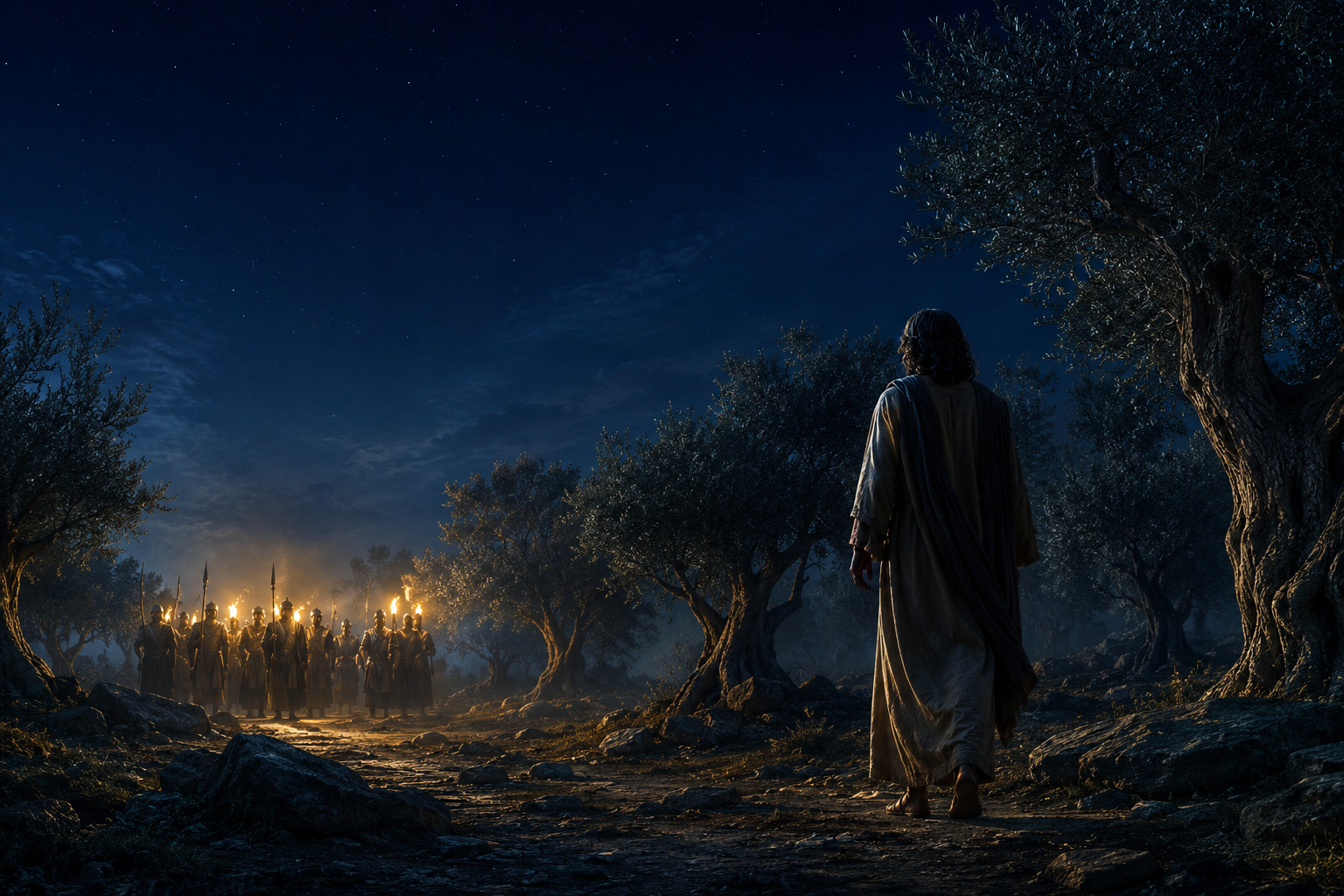
Gethsemane, a Passover night, around the year 30. An armed troop arrives: soldiers, Temple guards, torches, swords. Jesus knows what awaits him, he has announced it several times, and he could have fled: Galilee is three days' walk away, the night is dark, the garden opens onto the mountain. He does not flee. He steps toward the troop and asks: "Whom do you seek?" They answer: "Jesus of Nazareth." And then he utters a sentence that every man who has ever been afraid should read twice: "I am he. So, if you seek me, let these men go." (John 18:8)
Let us break down what has just happened. The leader has just surrendered himself and negotiated, in the same breath, the safe exit of his men. He is the only one the troop will take away that night. When everything goes wrong, he does not hide behind his group: he places his own body between the danger and his own. It is the exact opposite of the false leader, and it is the precise behavior for which soldiers follow a general into hell.
Peter's Paradox: You Can Disarm a Fighter, Not a Witness.
There is, within that same night, a story inside the story, and I believe it is one of the strongest proofs of this entire first part. It is Peter's story. It is almost always told badly, and by telling it badly, we miss what it demonstrates.
At the moment of the arrest, Peter, a fisherman, not a soldier, draws a sword and strikes. He cuts off the ear of a servant of the high priest. All four gospel accounts report the episode, and John names Peter explicitly (John 18:10). Let us pause on this gesture. Facing an armed troop, knowing perfectly well how Rome and the Temple dealt with rebellions, Peter draws his weapon. That night, he was ready to die in a battle lost in advance. And note the moment carefully: we are before Pentecost, before any outpouring of the Spirit. That courage did not yet come from any mystical experience; it came from the man he was fighting for. Three years of daily closeness to Jesus had been enough to make a fisherman ready to face a garrison. Men do not get themselves killed for a concept. They get themselves killed for a man who has shown himself worthy of their life.
But here is what happens next, and this is where everyone gets the reading wrong. Jesus turns to Peter and orders him: "Put your sword into its sheath" (John 18:11). Then he lets himself be bound, without resistance, and even heals the wounded man. Let us think for a second about what this order does to Peter. This man had a clear framework in his head: the master is in danger, you defend him by arms, you die if you must. His own leader has just taken that framework away from him. Peter finds himself in an impossible situation: ready to fight, forbidden to fight, and without any other weapon he knows. His only mode of combat has been confiscated, and no other has been given to him.
It is with this key that we must reread the famous denial scene, a few hours later. First, a fact rarely quoted: when the troop takes Jesus away, "they all forsook him and fled" (Mark 14:50). All, except two. Peter follows the troop all the way into the courtyard of the high priest; in other words, he walks into the enemy camp, a few hours after committing an armed assault on the servant of that very high priest. And John records a detail that almost nobody notices: among those who question him in the courtyard stands a relative of Malchus, the man Peter wounded. "Did I not see you in the garden with him?" (John 18:26). The danger was therefore very real; a direct witness of his sword blow was standing right there. A man afraid for his life would never have entered that courtyard. Peter entered it.
And yet, in that courtyard, he denies. Three times. Before whom? A servant girl, first (Mark 14:66-69), then unarmed people around a fire. Here is the paradox that the classic reading, the reading of "Peter the coward," is incapable of explaining: a coward stays silent before the armed troop and plays brave before a servant girl. Peter does exactly the opposite. He attacks soldiers sword in hand, then shrinks back before an unarmed servant. This behavior is incoherent if read as ordinary fear. It becomes crystal clear if read differently: between the garden and the courtyard, only one thing changed. His master disarmed him and gave himself up voluntarily. What collapsed in Peter was not his courage, it was his framework. Fighting had been forbidden to him. And testifying? Testifying to what? That night, there is not yet anything to testify to. Saying "yes, I am with him" would not have been dying as a witness, but dying for a cause collapsing before his eyes, beside a leader who refused to be defended. The courtyard of the high priest is the exact trough between two forms of courage: the old one, that of the sword, has just been taken from him, and the new one, that of testimony, does not yet exist, because what he will testify to has not yet happened.
This confusion had, moreover, an old root, and it is written in black and white in the text. Peter had never accepted the scenario of surrender. When Jesus announces his passion, it is Peter who takes him aside to protest: "Never, Lord! This shall never happen to you" (Matthew 16:22), and he gets put back in his place with stunning harshness. Peter always wanted a Messiah who fights. So when he lets out in the courtyard "I do not know this man," there is a terrible and almost literal sense in which it was true: this Messiah who lets himself be bound without a gesture, he does not know him, he never understood him, he even quarreled with him about it. Then the rooster crows, Jesus turns and looks at him, and Peter goes out to weep bitterly (Luke 22:62). Those tears say everything: this man does not himself understand what has just happened to him. These are not the banal tears of a coward; they are those of a fighter who has just discovered that he no longer knows how to fight.
Jesus, for his part, had seen this moment coming, and the way he had announced it confirms this reading: "Simon, Simon, Satan has demanded to sift you like wheat, but I have prayed for you that your faith may not fail. And when you have turned back, strengthen your brothers" (Luke 22:31-32). He does not treat the denial as the revelation of some deep cowardice; he treats it as a passage, with a mission for what comes after. And what comes after vindicates this reading spectacularly. A few weeks later, the same Peter stands before the Sanhedrin, before the very authorities who had his master crucified, and this time he does not shrink back, even though now he truly risks everything. What changed? He found his new weapon, and he names it himself: "We cannot but speak of what we have seen and heard" (Acts 4:20). The text notes that the judges, seeing the boldness of these "unschooled, ordinary men," were astonished (Acts 4:13). A powerful army can crush a rebellion; enough swords will do. But no one, no army, no empire, has ever found the means to contain the testimony of a man who says what he has seen and accepts to die rather than silence it. You can disarm a fighter. You cannot disarm a witness. Peter was both, and the night of the denial is precisely the moment when he was no longer the first and not yet the second. Remember this shift, for it is the hinge of this entire article.
Before Pilate: the Prisoner Who Masters His Judge.
In the morning, Jesus is handed over to Pontius Pilate. Here, we must first correct the image the cinema has left us. The Pilate of the movies has an embarrassed, almost gentle face. The Pilate of history, the one described by Philo of Alexandria and Flavius Josephus, is a brutal prefect, contemptuous of the Jews, who crushed unrest in blood and would eventually be recalled for excessive violence. And we must remember what Rome did to messianic agitators, for the Bible itself preserves the record. In Acts, the teacher Gamaliel reminds the Sanhedrin of the fate of Theudas, who was "claiming to be somebody" and gathered four hundred men: "he was killed, and all who followed him were dispersed." Then that of Judas the Galilean, who drew people after him: "he too perished, and all who followed him were scattered" (Acts 5:36-37). That is the routine. A leader rises, Rome kills him, the movement dies with him. That very morning, in fact, in Pilate's cells sits a certain Barabbas, "imprisoned with the insurrectionists who had committed murder in the uprising" (Mark 15:7). The stage is set: it is before that man, inside that system, that a Galilean preacher appears, abandoned by his own, without a lawyer and without support.
And then unfolds one of the most astonishing scenes in ancient literature. Pilate asks: "Are you the king of the Jews?" The prisoner, instead of begging or denying, answers with a question: "Do you say this of your own accord, or did others say it to you about me?" (John 18:34). Reread that line. The accused asks the judge to think for himself. He points out to him, in one sentence, that he is conducting a trial on the word of accusers whose claims he has not verified. Then he argues, with a logic any jurist would recognize: if my kingship were political, my followers would have fought, and you know there was no fight; I was arrested without resistance; nobody has reported to you a single call to arms from me. "My kingdom is not of this world" (John 18:36) is not a mystical dodge; it is exculpatory evidence, factual and verifiable by the judge.
We must also measure what this conversation was costing Pilate, for the prefect was caught in a political vise that the text exposes bluntly. Releasing a man whom the crowd calls "king of the Jews," a man who draws great crowds, means taking the risk that a report will make its way to Rome. And his accusers know it so well that they end up threatening him openly: "If you release this man, you are not Caesar's friend" (John 19:12). The title of Caesar's friend was not a polite formula; it was a status, a career, a life. The most elementary political calculation therefore commanded a quick condemnation, as with Theudas, as with Judas the Galilean. Yet the opposite happens: the text notes that Pilate is afraid (John 19:8) and that he "sought to release him" (John 19:12). The judge is afraid of the accused, and the executioner pleads for his victim against his own career interest. No scriptwriter seeking to flatter his hero would have written the scene this way, for it overturns every code of the ancient heroic narrative.
And let us not forget the state of the man who dominates this exchange. John specifies that the flogging has already taken place (John 19:1). The one answering the governor is a prisoner flogged with the Roman whip, exhausted, out of breath, who has not slept, and who knows that within a few hours he will have to carry the wood of his own execution to the killing ground. He will in fact collapse on the way, to the point that the soldiers will requisition a passerby, Simon of Cyrene, to carry the cross in his place (Mark 15:21). It is that man, in that state, who finds the strength to answer the governor's threat, "Do you not know that I have power to release you and power to crucify you?", with this sentence that has remained in history: "You would have no power over me unless it had been given you from above" (John 19:11). A tortured man explains to the representative of the most powerful empire in the world that his power is a borrowed power. No scream, no insult, no begging: a setting into perspective. The man about to die gives a lesson in political philosophy to the man about to kill him.
I believe, and here I offer you a personal conviction, that something happened in Pilate over the course of that morning. This man had rubbed shoulders with the kings the region produced, the Herods, those compromised, debauched monarchs, clinging to their thrones through Rome's favor, none of whom would have lifted a finger for their people, let alone given their life. And now he has before him a Galilean without an army who refuses to defend himself, who protects his own, who reasons better than his accusers and who does not tremble before the cross. When Pilate presents Jesus to the crowd saying "Behold the man" (John 19:5), then has an inscription nailed above the cross in Hebrew, Latin and Greek reading "Jesus of Nazareth, King of the Jews," and the religious leaders demand that he correct it to "he said he was king of the Jews," his answer cracks like a verdict: "What I have written, I have written" (John 19:22). I cannot probe the intentions of a Roman prefect dead for twenty centuries. But I read that stubborn refusal as the involuntary homage of a man of power who, among all the kings he had known, had finally met one who deserved the title, and who insisted on proclaiming it in the three languages of the known world.
The Hard Face and the Gentle Hand.
This mastery under threat was not a last-night accident; it was the style of his entire public life. Seven centuries earlier, the prophet Isaiah had written of the Servant to come: "I have set my face like flint" (Isaiah 50:7). That is exactly the man the gospels describe. Facing the religious class of his time, an elite that controlled the Temple, the economy of sacrifice, the law and respectability, Jesus is frontally harsh in a way we struggle to measure: hypocrites, whitewashed tombs, blind guides, brood of vipers (Matthew 23). He says this in public, to men who had the power to have him killed, in their city, during their feast, and he overturns the money-changers' tables in their own Temple. Every sentence of that kind was one more nail in his own cross. He knew it, and he kept going.
But here is what makes the character unique, for history produces hard men by the assembly line: the same mouth that thunders against the powerful becomes gentle with the weak. A woman caught in adultery is brought to him, in a legal trap where a woman's life serves as bait. He does not condemn the woman, nor does he launch into a tirade against the accusers: he bends down, writes on the ground, then lifts his head: "Let him who is without sin among you be the first to throw a stone at her" (John 8:7). The accusers withdraw one by one, beginning with the eldest. To the woman he simply says: "Neither do I condemn you; go, and sin no more." Hard on the powerful hypocrites, gentle with the woman on the ground. Ordinary leaders are one or the other. He is both, and each time in the right direction: hardness upward, gentleness downward. Look around you for men of power built this way. Take your time.
So, first question: this man, lucid under threat, logical before his judge, fearless before the corrupt, tender with the crushed, and who, at the hour of danger, designates himself so that his own may go free, would I follow him?
Yes. Without hesitation. As a man, as a leader, as a general: I would follow him, and I would not be the first fisherman to draw a sword for him.
But following is not worshipping. And this is where most speeches stop, whereas this is where everything begins.
The Threshold: From Cause to Testimony.
For after all, if the story of Jesus had ended on that Friday evening, in a sealed tomb, he would today be a footnote in the chronicles of Galilean preachers crushed by Rome, one more name on Gamaliel's list, between Theudas and Judas the Galilean. I would admire the man as I admire Socrates drinking the hemlock. I would not bow down, for nobody bows down before Socrates.
But something else happened, and it is here that I leave the terrain of the portrait to enter that of documented history. Remember Peter's shift, that trough between two forms of courage. Before the cross, Peter draws his sword for a cause: his leader, his movement, his hope. Then the cause collapses, the leader dies by the most degrading execution of the ancient world, the one that Jewish law itself associated with the curse, and the disciples hide. The dynamic is dead, as all dynamics die when the man who carried them dies; Gamaliel had said it, it is the law of the genre. And then, a few weeks later, the same men come back out in public, in Jerusalem itself, not in some distant province where nobody can verify, but in the city of the execution, under the authorities who ordered it, and they do not proclaim "his cause continues." They proclaim something infinitely more dangerous and infinitely more verifiable: "we have seen him alive." They are no longer militants; they are witnesses, and the difference between the two is the whole question. A militant dies for what he believes. A witness dies for what he has seen. One can die sincerely for a false belief received from others; history overflows with such cases. But one does not die for a lie one has fabricated oneself, as a group, without a single member of the group, ever, under any threat, recanting.
And that is exactly what the sources show. For at least four men of the first circle, Peter, Paul, James son of Zebedee, and James the brother of Jesus, whose stoning in the year 62 is reported to us by the Jewish historian Flavius Josephus, an external and non-Christian source, death for this testimony is attested at the highest degree of historical probability. And for the group as a whole, a negative fact of singular power: no ancient source, Christian, Jewish or Roman, reports the recantation of a single one of them. Not one. The movement's adversaries, who had every interest in parading a repentant apostle confessing the fraud, produced none.
Second Question: the Facts That Made Me Cross the Threshold.
I am a computer scientist by training. I like dated data, hostile sources, facts that survive crossfire. Here are three, and I invite every reader to verify them; that is, in fact, the entire purpose of the handbook I have published and link to at the end.
First fact: the worship was not built up over centuries of legend. It is there from the beginning, dated, and attested by enemies. In his first letter to the Corinthians, written around the year 54, Paul quotes a creed that he says he himself received, in the technical Jewish vocabulary of transmission: Christ died, was buried, was raised on the third day, appeared to Peter, to the Twelve, then to more than five hundred people "most of whom are still alive," in other words: go ask them. Scholars date the formation of this creed to two to five years after the crucifixion. And let me be precise: atheist scholars too. Gerd Lüdemann, a radical critic of Christianity, dates it to at most two years after the events. Two years. Legends require generations; here, there was not even a decade of silence to fill.
"They were accustomed to meet on a fixed day before dawn and sing responsively a hymn to Christ as to a god."
— Pliny the Younger, Roman governor of Bithynia, letter to the emperor Trajan, circa 112 AD
That sentence was not written by an evangelist. It was written by a persecutor, in an administrative report to his emperor, asking how to deal with these people. Pliny also describes his protocol: he ordered the accused to curse Christ, knowing that "those who are really Christians" cannot be forced to do so. Craftsmen, women, slaves of Asia Minor preferred to die rather than curse a Galilean carpenter crucified eighty years earlier, three thousand kilometers from their homes. When I state that Jesus was worshipped from the first century, I am not quoting my Bible. I am quoting the police records of the Roman Empire.
Second fact: on a purely documentary level, the file has no equivalent in Antiquity. I will be brief, for I have devoted an entire handbook to it: the complete biographies of Alexander the Great that have reached us were written four hundred years after his death; the oldest complete manuscripts of Plato date from twelve centuries after him; and nobody, in any university in the world, concludes from this that Alexander or Plato are myths. The gospels, for their part, stand thirty-five to seventy years from their subject, Paul's letters twenty years, the creed two years, and non-Christian sources, Tacitus, Josephus, Pliny, Suetonius, attest the man and his execution within the following century. The criteria that would cast doubt on Jesus would make all of Antiquity disappear, and the criteria that save Antiquity validate Jesus. Whoever doubts him in the name of "historical rigor" is not applying rigor: he is applying a double standard. And the double standard, as I have written in another context, is always the admission that one has abandoned method for ideology.
Third fact: a tree is judged by its fruit, and the fruit of this man changed the human condition. I have described elsewhere what the Roman world was: a world where one inhabitant of the Empire in five was a slave, where the law said servus non persona est, the slave is not a person, where one could use a human being to death without answering to anyone. It is in that world that a small community began to proclaim a mad sentence: "There is neither Jew nor Greek, there is neither slave nor free, there is neither male nor female" (Galatians 3:28). And to live it: same tables, same assemblies, where the patrician and the slave broke the same bread, something properly unthinkable in Rome. Paul sends the slave Onesimus back to his master Philemon with these words, unheard of for the era: receive him "no longer as a slave, but as a beloved brother." Entire communities pooled their money to buy slaves and set them free. In the fourth century, Basil of Caesarea built what historians consider the first great hospital complex open to the poor; the hospital, that institution we find "normal," is a direct fruit of this faith. And the emperor Julian, who tried to restore paganism and hated Christians, wrote this complaint, magnificent in what it concedes:
"The impious Galileans support not only their own poor but ours as well, while ours wait in vain for the help we owe them."
— the emperor Julian, known as the Apostate, letter to Arsacius, circa 362 AD
From this lineage, that of the equal dignity of every human being, not because he is strong, useful or a citizen, but because he is human, descend abolitionism, carried by Christians such as Wilberforce, and all the way to the modern idea of human rights. It is not an apologist who says so: it is the historian Tom Holland, who lost the faith of his childhood, and whose book Dominion (2019) demonstrates that the values of which the secularized West is proudest, the protection of the weak, equality, compassion as a public virtue, are Christianity that does not know itself. I argued in my article on democracy that the difference between the Roman master and us is the rule of law protecting the weak. Today I must add the link that came before, the one that article left in the shadows: first, an idea had to prevail, the idea that the weak person deserves protection. That idea has a historical origin. It has a birth date, a region, and a face. It entered the world through a crucified man.
The Objection I Raise Against Myself.
Faithful to my method, I formulate against myself the best objection, not the most convenient one. Here it is: "Sincere people can be sincerely mistaken. The apostles may have hallucinated. Their death proves their good faith, not their truth."
The objection is serious and deserves a serious answer. The sincerity of the witnesses, first of all, is no longer the debate: their death without recantation establishes it, and critical scholarship abandoned the fraud thesis two centuries ago. So hallucination remains. But hallucinations are private events: they are not shared by twelve, still less by five hundred. The psychology of grief produces the fleeting feeling of a presence, not the durable and collective conviction of a bodily resurrection, a category that Judaism reserved for the end of times and that no grief would have spontaneously invented for an individual in the middle of history. It does not explain Paul, a persecutor of the movement, who was not grieving. It does not explain James, the skeptical brother who thought Jesus was out of his mind (Mark 3:21, a detail too embarrassing to be invented) and who ended up stoned as head of the church of Jerusalem.
And above all, it does not explain the simplest fact of all: to kill the movement in the cradle, it would have been enough to go to the tomb and display the body. Nobody did it. Yet this tomb was not some forgotten spot whose address had been lost. The authorities, precisely because they remembered that Jesus had announced his resurrection, had obtained from Pilate a detachment of guards, had the stone sealed and posted the soldiers in front of it (Matthew 27:62-66). What follows is even more instructive. When the tomb is found empty, what do the authorities do? They do not produce the body. They do not drag the disciples to court for grave robbery. Matthew reports that they give the guards "a large sum of money" to say that the disciples stole the body while they were sleeping, promising to cover for them before the governor (Matthew 28:11-15), a promise that speaks volumes, for a soldier who lost what he was assigned to guard answered for his failure, sometimes with his life; the book of Acts, in fact, shows guards executed over an escape (Acts 12:19). And that official story, still circulating among the Jews at the time Matthew writes, self-destructs on first reading: sleeping witnesses cannot know who took the body. But here is the most important point, and I want it to be seen clearly: the accusation of theft concedes precisely that the tomb was empty. Neither the authorities of the moment, nor the Jewish polemic of the following centuries, ever claimed that the body was still there. The best attestation of the empty tomb comes to us from its adversaries. Every naturalistic explanation covers one fact by sacrificing the others. A single explanation covers them all. I leave each person to measure what refusing it costs him, and to check whether that refusal proceeds from his investigation, or from his environment.
So, Why Am I a Christian?
Let us retrace the path. I asked two questions, refusing to mix them.
This man, would I follow him? Yes, for what he was: the only type of leader worth following, the one who exposes himself for his own instead of exposing his own for him, hard on the powerful, gentle with the crushed, free before death to the point that his judge was afraid of him and engraved, despite his accusers, in three languages, the title of king.
This man, would I worship him? An admirable man, no. But the facts led me further than admiration: a proclamation of resurrection dated two years after the events, in the very city of the execution; direct witnesses dead without a single one recanting; an empty tomb that even the adversaries concede; a worship attested by the police records of the Empire that persecuted him; a documentary file that only a double standard allows one to dismiss; and twenty centuries of fruit, the slave become brother, the hospital, the dignity of the weak, which made the world from which I can, precisely, write these lines freely. So my answer is yes. I bow down. Not in spite of my reason, but with it, my reason leading the way.
I was born a Christian by inheritance. I remained one by investigation. The cradle gave me the question, it did not dictate the answer: the answer, I went looking for it in the documents, among the hostile witnesses, in the dates, and I now hold it the way one holds a conclusion, not the way one wears a habit. To those who believe the way one inherits, without ever having opened the file: your faith rests on a foundation more solid than you imagine, go and see. To those who doubt the way one inherits, without ever having opened the file: your doubt rests on a foundation more fragile than you imagine, go and see as well. The mirror, once again, is the same for everyone. The only indefensible position is never to look into it.
For those who want to verify, go deeper, or contradict me on the record: I have gathered the sources, the dates, the historical criteria and the answers to the best objections in a complete handbook, freely downloadable and shareable. The link is at the end of this article.
In Brief
The method: two separate questions, without mixing the registers. Does the man deserve to be followed? Then, and only then: does he deserve to be worshipped?
The man: at Gethsemane, he designates himself so that his own may go free, the exact opposite of leaders who send others to die. Before Pilate, a brutal prefect caught in a political vise, the flogged prisoner argues with such composure that the judge becomes afraid, seeks to release him against his own interest, and engraves "King of the Jews" in three languages, refusing to correct it.
Peter's paradox: a coward stays silent before soldiers and plays brave before a servant girl; Peter does the opposite. His courage did not fail, his framework collapsed: disarmed by his own master, he no longer had a weapon, and did not yet have a testimony. After the resurrection, he finds the new weapon: "We cannot but speak of what we have seen" (Acts 4:20). You can disarm a fighter, not a witness.
The shift: a militant dies for what he believes, a witness dies for what he has seen. At least four men of the first circle died for this testimony. No ancient source reports a single recantation.
The dates: the creed of 1 Corinthians 15 (death, resurrection, appearances) is dated two to five years after the crucifixion, including by atheist scholars. Legends require generations; here, two years.
The tomb: guarded by soldiers and sealed by order of the authorities, then, once empty, an official story bought with "a large sum of money" that self-destructs: sleeping witnesses see nothing. The theft accusation concedes the essential point: even the adversaries never claimed the body was still there.
Enemies as sources: Pliny the Younger, a persecutor, attests around 112 AD that a hymn is sung "to Christ as to a god." The emperor Julian, an enemy of Christianity, complains that Christians feed the pagans' poor as well.
The fruit: "neither slave nor free" proclaimed at the heart of a slaveholding empire, the ransoming of slaves, the first hospital, the dignity of the weak, all the way to human rights. A demonstration carried by a non-believing historian, Tom Holland, in Dominion.
The conclusion: born a Christian by inheritance, remained one by investigation. Follow: yes. Worship: yes. Not in spite of reason, but with it.